
An online tool for frequent business travellers
Dopplr launched in 2007 in London, the work of Lisa Sounio, Marko Ahtisaari, Matt Biddulph, and Matt Jones. The pitch fit in one breath: you entered your future trips, the contacts you chose could see them, and when two itineraries landed in the same city at the same time, Dopplr told you both. Their own copy said it best: notice coincidences when your travels overlap
.
The people
- Founded
- 2007, London 1
- Leadership
- Lisa Sounio, founding investor and CEO from launch until December 2008, then Chairman of the Board. Marko Ahtisaari, co-founder and CEO from January 2009. Matt Biddulph, co-founder and CTO. Matt Jones, co-founder and CDO. 13
- Notable investors
- Reid Hoffman, Esther Dyson, Tyler Brûlé, and Joi Ito, among others across two funding rounds 1
- Total raised
- Reportedly around €1.25 million, though exact figures were never officially announced 1
It struck a chord. In early 2008 a Guardian Media Group survey named Dopplr a company to watch, and its most famous fan put it plainly:
"You put in your travel schedule and link to your friends. It allows you to see where everyone is. I love it."
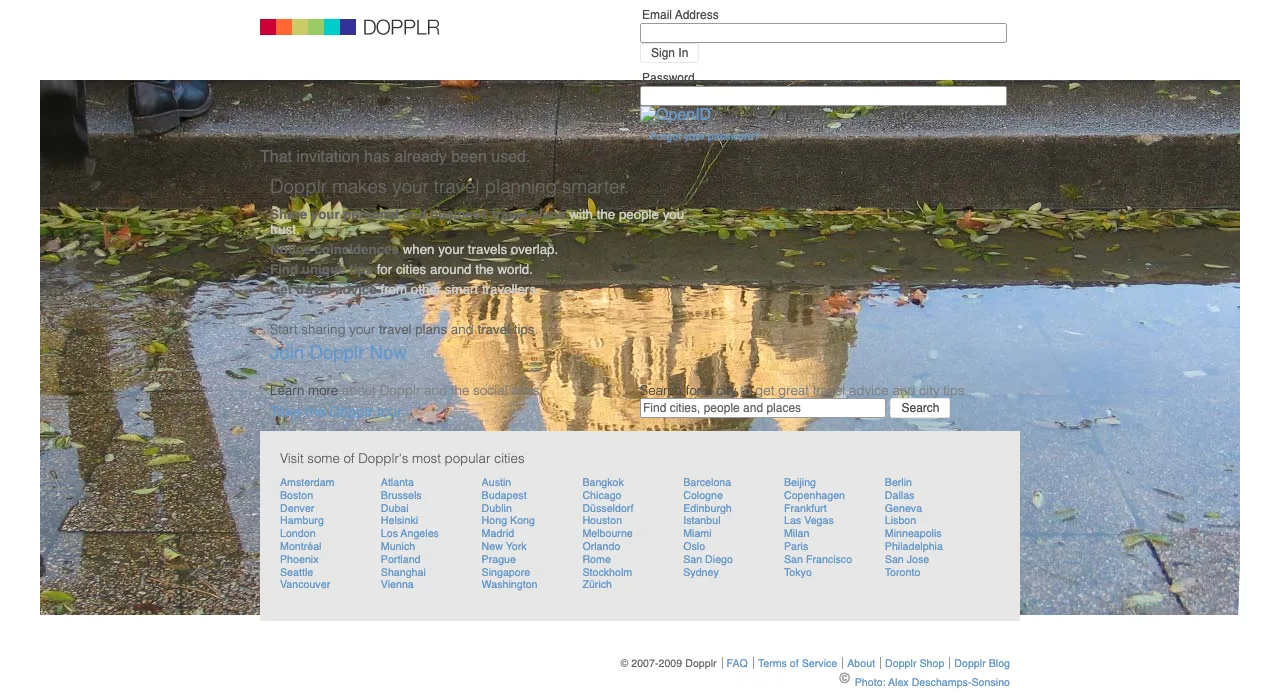
dopplr.com in May 2009, restored from the Internet Archive's Wayback Machine. The header photograph on the original page is credited to Alex Deschamps-Sonsino.
Why it was lovely
Dopplr was private by default. Your plans were visible only to the people you chose, one by one. It never introduced you to strangers and never tracked you live: it worked on where you would be, not where you stood. That restraint made it feel like a tool for adults, and it left the magic to the coincidences themselves.
And it was crafted with wit. In January 2009 every member received a Personal Annual Report: a beautifully typeset PDF of their year in motion, with your total distance expressed as a share of the way to the moon and your average velocity compared to a running animal. One report was famously generated for Barack Obama, from his public 2008 campaign schedule. Joi Ito called the design so classy it hurts
, and he was not alone.
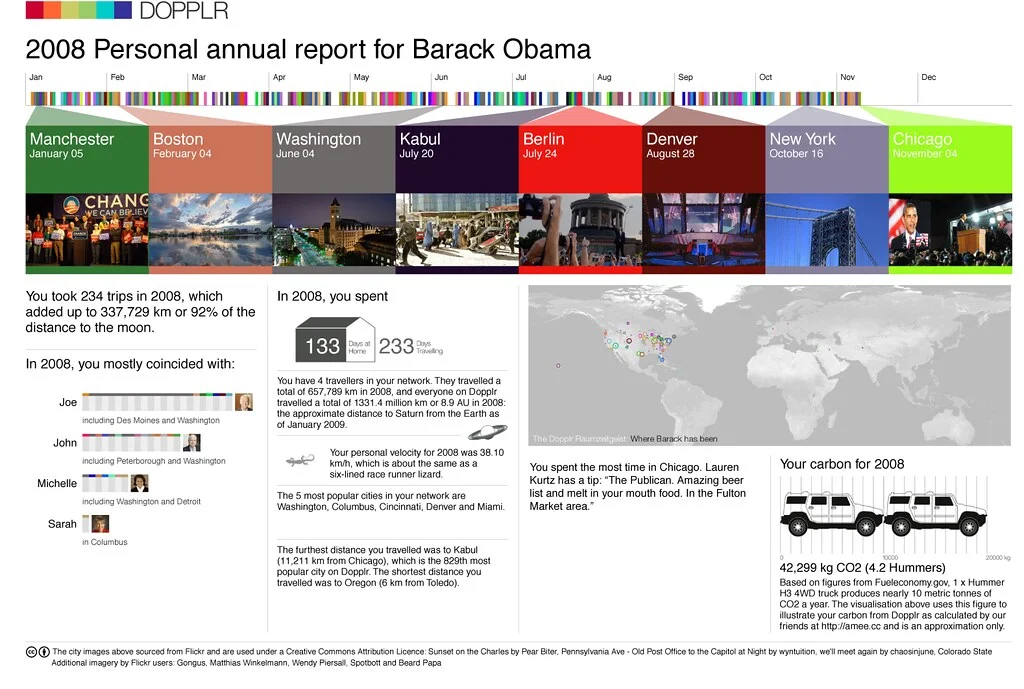
The 2008 Personal Annual Report for Barack Obama. Source: Dopplr on Flickr, licensed CC BY-SA 2.0; converted to WebP from the original.
Every detail rewarded a second look. Each city had its own color, the year became a striped timeline of those colors, and a world map plotted everywhere you had been. Dopplr called that map the Raumzeitgeist.
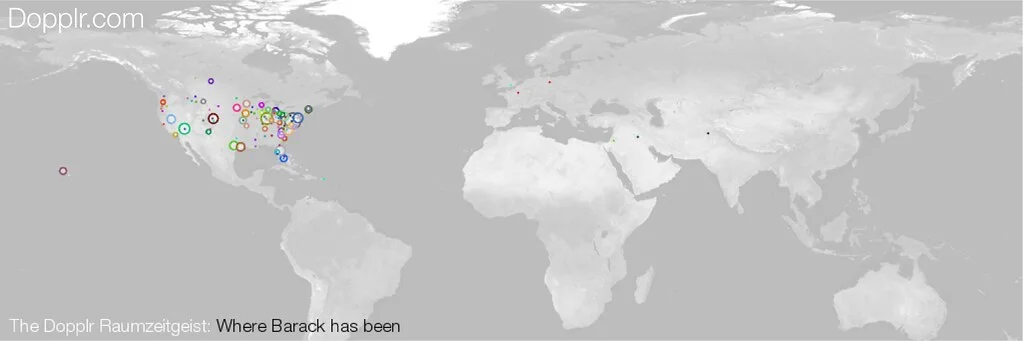
The Raumzeitgeist map from the same report: where Barack has been. Source: Dopplr on Flickr, licensed CC BY-SA 2.0; converted to WebP from the original.
People noticed what the craft was doing. Writing in March 2009, the digital culture researcher Jill Walker Rettberg put it this way:
"With the annual reports, Dopplr turns my raw data into a visual diary, and it does it beautifully."
The exit
Nokia acquired Dopplr in a deal never publicly priced. By the numbers it was a decent outcome: the founders had built something genuinely loved, and the team landed well. Marko Ahtisaari became Nokia's head of design, and part of the engineering team moved to Nokia in Berlin.
The deal
What happened after
Inside Nokia, the service went quiet. Monthly visitors fell within the first year, development stopped in 2010, and on November 1, 2013 Dopplr shut down for good. Was it doomed anyway? Nobody can say; Nokia ran into its own crisis two years after the purchase. What is certain is simpler: the idea went into Nokia and never came out.
What apreet carries forward
We think the idea was right and the timing was hard. apreet gives it another run, for the people it always served best: professionals who travel. apreet reads your calendar events, never their notes, and suggests people from your own address book near each destination. A mutual itinerary match needs you both on apreet, trips that overlap in time and place, and each other's numbers on both phones. Private by default, no strangers, and the coincidences do the rest. You can read the full mechanism on how apreet works.
Sources and further reading
- Dopplr on Wikipedia: founding, founders, acquisition, and shutdown dates.
- TechCrunch, September 23, 2009: Nokia to acquire UK startup Dopplr, the first report of the rumored price.
- TechCrunch, September 24, 2009: Congrats to Dopplr? Maybe., a skeptical follow-up on the deal.
- TechCrunch, September 28, 2009: Dopplr confirms being acquired by Nokia.
- Nokia, September 28, 2009: Nokia acquires Dopplr, the official announcement.
- Financial Times, 2009: ft.com, Nokia's own account of the price, reported as "a fraction" of the rumored €10–15m TechCrunch figure.
- Joi Ito, January 2009: 2008 Dopplr Personal Annual Report.
- Jill Walker Rettberg, jilltxt.net, March 2009: Personal data visualisation: Dopplr, Dailybooth, Flickr and Trixietracker.
- Stowe Boyd: Dopplr disappeared into the black hole that is Nokia.
- Dopplr on Flickr: the annual report images used above, licensed CC BY-SA 2.0.
- The Internet Archive's Wayback Machine: dopplr.com in October 2008 (the homepage carrying the Jimmy Wales quote) and in May 2009 (the screenshot above).
- Full licensing detail for every image on this page: Credits.
- ArcticStartup: Marko Ahtisaari is Dopplr's new CEO, and Dan Gillmor, December 8, 2008: Marko Ahtisaari, new Dopplr CEO, the source for the CEO transition dates above.