

Quick answer. David Rockefeller, the Chase Manhattan chairman who died in 2017 at 101, kept one of the most famous contact files of the analog age: a card for nearly everyone he met, updated over decades. By most counts it held between 100,000 and 200,000 contacts. Each card captured context, not just a name: where they last met, what was said, titles, addresses, even family details. The point was never storage. It was preparation.
Rockefeller reviewed a card before he walked into the room. apreet shows you who matters before you arrive in the city.
Key takeaways
- David Rockefeller kept one of the most famous Rolodex-style contact files ever documented.
- Reports estimate it held between 100,000 and 200,000 contacts.
- The cards stored context: where people met, what they discussed, titles, addresses, and family details.
- The point was not storage. It was preparation before the next meeting.
- apreet applies the same habit to business travel, showing who you already know in the city you are about to visit.
A relationship machine on the 56th floor
Rockefeller's Rolodex was not a desk gadget. It was a custom-built machine, reported to stand about five feet high, 1 that lived in its own room in Room 5600, the Rockefeller family offices on the 56th floor of 30 Rockefeller Plaza. 2 The file grew so large it needed the space.
The records were plain 3-by-5-inch index cards, typed and then annotated by hand. They tracked far more than a name and a number. A card carried the dates and places of meetings, a spouse's name, changes of title and address, and, in time, even the date of death. Rockefeller referred to himself as "DR" in the notes. He kept the system current for decades, and the staff around him kept it fed.
Counts of the file vary, which is worth saying plainly. The Wall Street Journal, given rare access in 2017, described a collection of about 100,000 contacts. 3 The New York Times put it at 150,000 names. 4 The Daily Mail reported as many as 200,000 cards. 5 Whichever number is right, the scale is the same: a working memory of a life spent meeting people.
The cards held context, not just contacts
What made the file powerful was the detail. Rockefeller wrote down the things that turn a name into a relationship. On John F. Kennedy's card he noted where they first met and a book Kennedy had written. On Nelson Mandela's card he recorded the proper form of address, "His Excellency," and reminded himself that at a dinner on 5 July 1983 Mandela had given him a beaded belt.
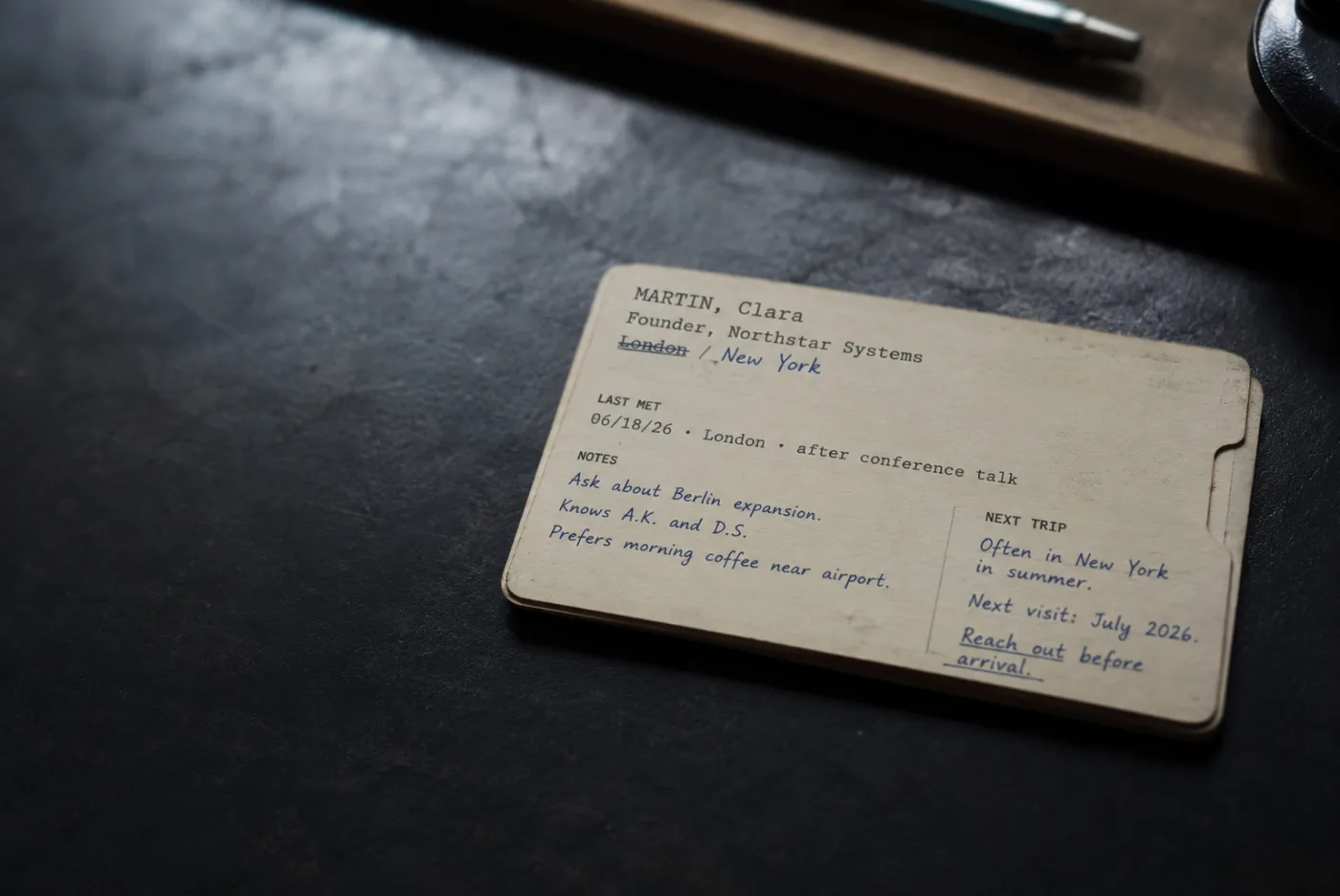
Henry Kissinger, a close friend of decades, is said to have earned the most cards of anyone in the file. Rockefeller reportedly gave Kissinger his own stack of them in 2015. In his 2002 memoir, Rockefeller explained the whole purpose in one line:
I can quickly review the nature of my past associations before seeing someone again.
The Wall Street Journal called the collection "the ultimate expression of communication in the analog age." 3 The medium has dated. The instinct behind it has not.
Why one of the world's best-connected people kept cards
Rockefeller traced the habit to the war. He served as an Army intelligence officer in North Africa and France, and later said the work taught him how much depended on knowing the right people. He put it directly:
My effectiveness depended on my ability to develop a network of people with reliable information.
He carried that lesson into a long career. Over the years he visited 103 countries and met more than 200 heads of state, and he kept working and traveling well into his nineties. The card file was how one person stayed close to a network that large. The deeper idea, that loose and lasting connections carry real value, is the same one we cover in the science of weak ties.
The Rolodex was never about storage. It was about timing.
Rockefeller did not prize the cards for holding names. He prized them for the moment just before a meeting, when a glance reminded him who someone was and why the relationship mattered. The value was timing, not filing.
Your own version of that file already exists. It is just scattered. The names sit across your phone, your inbox, your calendar, LinkedIn, WhatsApp, and your memory. Nobody is going to type you a 3-by-5 card. And no card, however detailed, would tell you the one thing Rockefeller could not automate: that a person you know is about to be in the same city as you.
That is the idea apreet is built on: relationships need moments, and travel is what creates them.
From Rolodex to apreet
| Then: Rockefeller's Rolodex | Now: apreet |
|---|---|
| A card before a meeting | A contact before a trip |
| Names plus relationship context | Contacts plus travel timing |
| Updated by hand over decades | Triggered by your calendar and address book |
| Useful before entering a room | Useful before arriving in a city |
| Built for one person's memory | Built for modern business travel |
Your traveling Rolodex, finally on the road
apreet brings the habit back for people who travel for work. You connect your calendar and your contacts. Before a trip, apreet shows which friends, contacts, and colleagues will be near you, so you can turn a passing visit into a real meeting with someone you already know.
It is not another address book, and it is not a traditional CRM. It is the timing layer on top of the network you already have. That is what makes apreet different from a CRM, LinkedIn, or another contacts app: it is built around the moment when travel creates a reason to reconnect. See how apreet works, or the detail behind itinerary matching.
Rockefeller's file was guarded for a reason, and yours deserves the same care. apreet is built privacy-first. Your address book stays yours, you decide what to connect, and nothing is sent on your behalf. We explain exactly what apreet reads and what it never changes in privacy and your data.
Rockefeller reviewed a card before he walked into the room. apreet shows you who matters before you arrive in the city. Your contacts are already there. Your calendar already knows where you are going. apreet connects the two, so the right meeting has a chance to happen.
Try apreet free on your next trip →
Sources
- Gallo, C., "David Rockefeller's Rolodex Offers a Master Class in Making Friends and Influencing People," Forbes, December 7, 2017: forbes.com.
- Rockefeller Archive Center, "David Rockefeller Personal and Professional Papers, Rolodex Cards, RG 6": dimes.rockarch.org, the official archival record of the card file itself (open for research in 2042 under the access terms).
- The Wall Street Journal, "David Rockefeller's Famous Rolodex Is Astonishing. Here's a First Peek," 2017: wsj.com, the paper's rare look inside the file, with example cards and the "analog age" line.
- Purdum, T. S., "A Toast to David Rockefeller," The New York Times, March 21, 2017: nytimes.com, the 150,000-name figure.
- Flynn, S., "How the late David Rockefeller built up an incredible catalog of 200,000 index cards," Daily Mail, December 31, 2017: dailymail.com.